

Some actors become so closely associated with iconic characters that audiences almost forget the extraordinary careers behind them. Sir Patrick Stewart was one such performer. For millions, he was Captain Jean-Luc Picard, the thoughtful commander of the USS Enterprise, or Professor Charles Xavier, the compassionate mentor of the X-Men. But long before international fame arrived, Stewart had established himself as a distinguished Shakespearean actor, building his craft on Britain’s most respected theatrical stages.
Sir Patrick Stewart died on October 28, 2026, aged 86, at his home in Los Angeles. His passing marked the loss of an actor whose work crossed generations, genres and mediums. Yet remembering his career means looking beyond his most famous characters to appreciate the remarkable versatility of the artist who brought them to life.
From Shakespeare to the Screen
Born in Mirfield, West Yorkshire, in 1940, Patrick Stewart discovered his love for acting through Shakespeare. Encouraged by an English teacher during his school years, he went on to train at Bristol Old Vic Theatre School before joining the Royal Shakespeare Company in 1966.
His theatrical career helped shape the qualities that audiences would later recognise in his screen performances: a commanding voice, precise delivery and an ability to bring complexity to a character.
Stewart never abandoned the stage after achieving television and film success. He continued performing Shakespeare and other celebrated theatrical works throughout his career, including Hamlet, Macbeth and The Tempest.
His classical training would eventually become one of the defining influences on two of popular culture’s most recognisable characters.
Jean-Luc Picard and Professor Charles Xavier: Two Iconic Roles
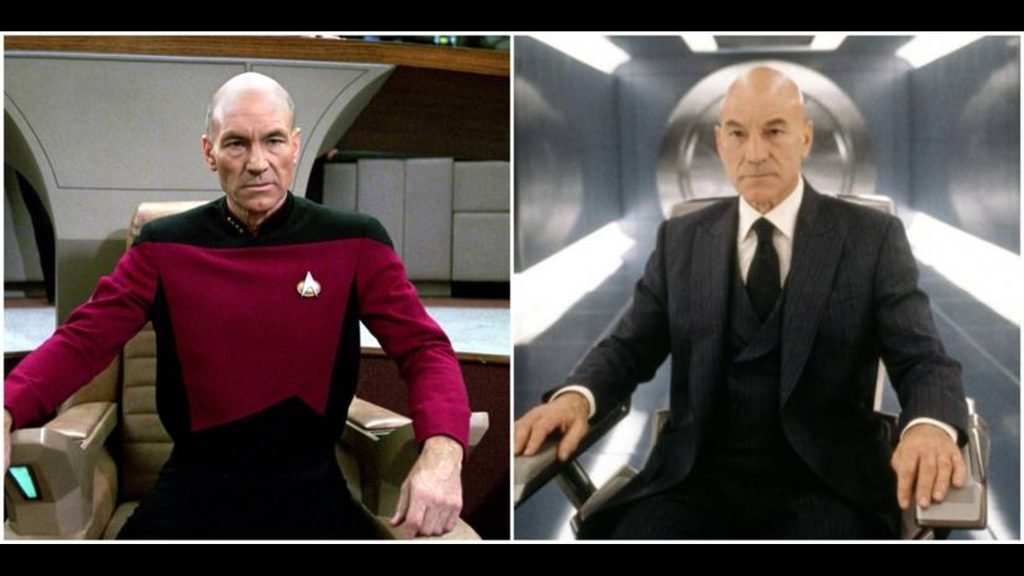
In 1987, Stewart became Captain Jean-Luc Picard in Star Trek: The Next Generation. His portrayal introduced audiences to a different kind of science-fiction leader: thoughtful, diplomatic, intellectually curious and guided by a strong sense of responsibility.
Across seven seasons, four feature films and his eventual return in Star Trek: Picard, Stewart developed Picard into one of the franchise’s most enduring characters. His performance gave the captain an authority rooted in intelligence and humanity rather than simply command.
In 2000, he entered another major entertainment universe as Professor Charles Xavier in X-Men. As the founder and mentor of the X-Men, Xavier believed in coexistence between humans and mutants, even when the world around him was defined by fear and prejudice.
His relationship with Ian McKellen’s Magneto gave the films an especially compelling dynamic, with their characters representing contrasting responses to discrimination and survival.
Stewart returned to Xavier across several films, delivering one of his most affecting performances in Logan (2017), which explored a more vulnerable side of the character.
Although Picard and Xavier belonged to very different fictional worlds, both reflected qualities that Stewart brought naturally to his performances: intelligence, conviction, restraint and compassion.
Beyond the Franchises: An Actor of Many Talents

Stewart’s career was never limited to science fiction or superhero cinema. His filmography included David Lynch’s Dune (1984), Excalibur (1981), the historical television drama I, Claudius and the thriller Green Room (2015), in which he delivered a chilling performance as an antagonist.
He also demonstrated a wonderful sense of humour. From Robin Hood: Men in Tights to the animated comedy American Dad!, where he voiced Avery Bullock, Stewart proved that his commanding screen presence could be just as effective in comedy.
His distinctive voice became another part of his legacy. He performed Pharaoh Seti in The Prince of Egypt (1998), contributed to other animated productions and earned a Grammy Award for his spoken-word performance of Peter and the Wolf.
These performances reveal an actor who was comfortable moving between classical drama, fantasy, comedy, animation and psychological thrillers. His range deserves recognition alongside his most celebrated roles.
The Friendships and Life Beyond the Characters

One of the most memorable relationships associated with Stewart’s career was his friendship with fellow actor Sir Ian McKellen.
Their association extended from the theatrical world to the X-Men films, where they portrayed the ideological opponents Professor Xavier and Magneto. Off screen, however, the two shared a close friendship and reunited for theatre productions including Waiting for Godot and No Man’s Land.
McKellen also officiated Stewart’s wedding to singer-songwriter Sunny Ozell in 2013, making their friendship an especially meaningful part of both actors’ personal stories.
Stewart maintained a connection to his Yorkshire roots, serving as Chancellor of the University of Huddersfield from 2004 to 2015. He was knighted in 2010 for services to drama and supported causes including human rights and domestic violence awareness.
In 2023, he published Making It So: A Memoir, offering readers a personal account of his journey from Yorkshire to international recognition.
Remembering an Extraordinary Career
It would be easy to remember Sir Patrick Stewart through two names: Jean-Luc Picard and Charles Xavier. Both characters became cultural landmarks, introducing his talent to audiences across generations.
But his legacy extends much further.
There was the Shakespearean actor who built his craft on the stage, the performer who moved comfortably between drama and comedy, the unmistakable voice and the artist who continued exploring new creative possibilities throughout his career.
For some, he will always be the captain who believed in diplomacy. For others, he will be the professor who championed understanding and coexistence. And for theatre lovers, he will remain an accomplished Shakespearean performer whose stage career deserves to be celebrated in its own right.
Sir Patrick Stewart leaves behind more than memorable characters. He leaves behind an extraordinary body of work and a reminder that a truly remarkable acting career can never be defined by just two roles.
Leave a Reply