
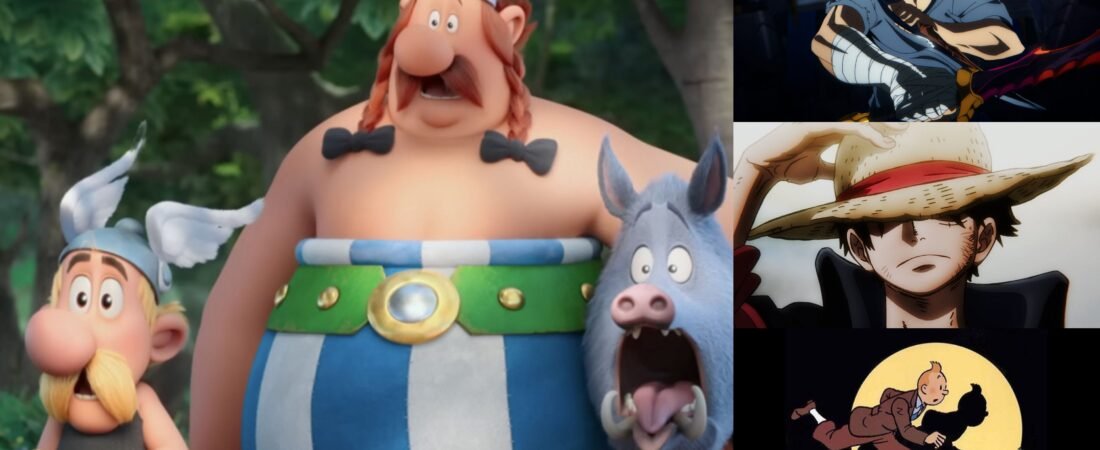
Some characters feel as though they’ve always been around. They turn up in childhood reading, television adaptations, films, merchandise and conversations with people from entirely different generations. We might remember their catchphrases, recognise their faces or know exactly what happens when they enter a room. But how often do we remember who created them — or where their stories began?
Comics have travelled remarkably far from their places of origin. Belgian reporters have found readers in India, Japanese pirates have become global icons, and characters born in Latin American newspapers have crossed language barriers to reach new audiences. The continuing popularity of Solo Leveling offers a timely reminder of how illustrated stories evolve, move between formats and find new audiences.
Here’s a little tribute to the people behind these illustrated worlds — the creators we rarely acknowledge, and, in some cases, the visionaries whose work we’ve enjoyed without ever knowing their names.
1. Tintin — Belgium
Created by Hergé (Georges Remi) through Le Petit Vingtième · 1929
Tintin, the young reporter accompanied by his dog Snowy, became one of the most recognisable characters in Belgian bande dessinée (BD), the French term for the region’s comic-book tradition. His adventures take him across continents, through mysteries involving politics, archaeology and international intrigue. Captain Haddock and Professor Calculus eventually become equally familiar members of his world.
Tintin also found an unexpected place in Bengali popular culture. Satyajit Ray’s Feluda stories contain references to the reporter’s adventures, including Tintin in Tibet in A Killer in Kailash. The character’s reach is a reminder of how European BD travelled into readers’ lives far beyond its original audience.
2. One Piece — Japan
Created by Eiichiro Oda · 1997
Few manga adventures have travelled as far as One Piece. It follows Monkey D. Luffy, who dreams of becoming King of the Pirates. His journey brings together the Straw Hat Pirates, including swordsman Zoro, navigator Nami, cook Sanji and the rest of the crew. What begins as a treasure hunt develops into a sprawling story about friendship, freedom and loyalty.
Also Read: Best anime of 2026 so far: Frieren 2, Jujutsu Kaisen 3 & more
The manga’s popularity grew through its long-running anime, which began in 1999, and Netflix’s live-action adaptation. In March 2026, the series reached another milestone, with worldwide circulation reported to have crossed 600 million copies. Oda’s creation has become a global phenomenon while retaining the adventurous spirit and distinctive humour that made readers fall in love with Luffy’s world.
3. Solo Leveling — South Korea
Created by Chugong · Manhwa illustrator: DUBU (Jang Sung-ra) · 2016
Not every comic begins on a printed page. Solo Leveling started as a South Korean web novel by Chugong in 2016 before becoming a hugely popular manhwa — the Korean form of comics — in 2018.
It follows Sung Jinwoo, initially considered one of the weakest hunters in a world where dangerous portals connect humanity to monster-filled dungeons. An extraordinary encounter gives him access to a system that allows him to grow stronger.
The anime adaptation brought the franchise to another international audience, while a live-action Netflix project featuring Byeon Woo-seok and Han So-hee was also announced. Its universe continued through Solo Leveling: Ragnarok, which follows Jinwoo’s son, Sung Suho. The franchise demonstrates how Korean web fiction and manhwa can develop into international multimedia properties.
4. Sindibad — Egypt and the Arab world
Children’s magazine launched in Cairo · 1952
Unlike the other entries, Sindibad isn’t one superhero or a single comic series. It was an influential Egyptian children’s magazine that helped introduce generations of young readers to illustrated storytelling.
Launched in Cairo in 1952 by Dar el-Ma’arif, the magazine was edited by Mohammad Said el Aryan, with celebrated Egyptian artist Hussein Bikar among its principal illustrators. It presented itself as a publication for children across the Arab world and diaspora, combining illustrated stories with an educational outlook.
Its name evokes Sindbad the Sailor, the legendary traveller whose adventures have crossed storytelling traditions for centuries. Indian audiences might recognise the name from the song ‘Sindbad the Sailor’ in Rock On!!. That song, however, refers to the legendary sailor rather than the Egyptian magazine — a small but interesting distinction between two cultural references.
5. Asterix — France
Created by René Goscinny and Albert Uderzo · 1959
Asterix lives in a small Gaulish village that continues to resist Roman occupation, thanks largely to a magic potion that gives its inhabitants extraordinary strength. Alongside his larger companion Obelix, he travels through a world filled with historical references, wordplay, satire and affectionate humour.
The series became a defining work of French bande dessinée, often using its ancient setting to poke fun at authority, national stereotypes and everyday human behaviour. Its popularity led to animated productions, live-action films and other adaptations. Netflix’s Asterix & Obelix: The Big Fight introduced another screen interpretation, demonstrating how a village from ancient Gaul continues to find new audiences more than six decades after its arrival.
6. Archie — United States
Conceived by John L. Goldwater with writer Vic Bloom and artist Bob Montana · 1941
For generations of readers, Riverdale High has been a familiar world of teenage friendships, rivalries and romantic confusion.
Archie Andrews’ world revolves around school life, friendships and the familiar complications involving Betty Cooper, Veronica Lodge and Jughead Jones. The character’s creation drew inspiration from the popularity of wholesome American teenage stories, including the Andy Hardy films.
The series became a long-running part of American comic-book culture through its humour and everyday teenage situations. Its characters eventually moved into animated productions, television and film, reaching audiences who may never have picked up the original issues. The darker television interpretation Riverdale offered a very different take on the familiar setting, while the original comics remain associated with the lighter misadventures of a group of teenagers.
7. Dennis the Menace and Gnasher — United Kingdom
Created for The Beano · 1951
A striped jumper, spiky hair, a mischievous grin and a dog who is usually part of the trouble: Dennis is one of British children’s comics’ most recognisable characters.
The British Dennis the Menace first appeared in The Beano on 17 March 1951. His dog Gnasher joined the adventures in 1968, becoming an equally memorable part of the strip. Together, they turned everyday school and neighbourhood life into a stream of pranks and comic mischief.
This Dennis is distinct from the American comic-strip character of the same name, who also appeared in the early 1950s.
In 2026, the Royal Mint marked the British character’s 75th anniversary with a commemorative 50p coin featuring Dennis and Gnasher. It’s a fitting tribute to a comic troublemaker whose appeal has lasted for three quarters of a century.
8. Mortadelo y Filemón — Spain
Created by Francisco Ibáñez · 1958
Spain’s famously chaotic secret agents have a talent for turning even the simplest assignment into a disaster. They work for the fictional organisation TIA. Their assignments rarely go according to plan: Mortadelo’s elaborate disguises and Filemón’s increasingly desperate attempts to manage the situation create a steady stream of visual comedy.
The duo eventually moved beyond Spanish historieta into animated and live-action films. The 2014 animated feature Mortadelo y Filemón contra Jimmy el Cachondo, directed by Javier Fesser, won two Goya Awards in 2015, including Best Animated Film and Best Adapted Screenplay. The series remains a distinctive example of how a locally rooted comic tradition can build a substantial audience through humour that crosses generations.
9. Mafalda — Argentina
Created by Quino (Joaquín Salvador Lavado Tejón) through Primera Plana · 1964
Mafalda may be a little girl, but her questions are often far bigger than the adults around her are prepared to answer. Through conversations with family and friends, the strip explored politics, inequality, consumerism, education and everyday life.
Her impatience with the state of the world made her an unusual comic-book character: a child who often seemed to understand adult problems better than adults themselves. Her friends, including the practical Manolito and the gentle Felipe, offered contrasting perspectives and added warmth to the satire.
The strip ended in 1973, but Mafalda continued through animated adaptations and international publications. Netflix announced a new animated series directed by Juan José Campanella in 2024.
The creation remains a reminder that humour can be a powerful way to ask uncomfortable questions.
10. Condorito — Chile
Created by René Ríos Boettiger (Pepo) through Okey · 1949
With his oversized feet, distinctive beak and mischievous sense of humour, Condorito became one of Latin America’s most familiar comic characters. The character followed the adventures of an anthropomorphic condor living in the fictional town of Pelotillehue.
Condorito’s creation is often linked to Pepo’s dissatisfaction with Disney’s 1942 film Saludos Amigos, which represented Chile as Pedrito, a small mail plane struggling to cross the Andes. Pepo instead imagined a condor, an Andean bird, as a more fitting symbol of Chilean identity.
His popularity eventually extended to animation. Condorito: The Movie, released in 2017, brought the character to the big screen. What began as a distinctly Chilean creation grew into a character recognised across Latin America.
11. Old Master Q — Hong Kong
Created by Alfonso Wong · 1962
A bald-headed man with a traditional Chinese skullcap, a mischievous expression and an appetite for getting into awkward situations: Old Master Q is a landmark of Hong Kong comics. Wong’s humour draws on everyday life, misunderstandings and the contrast between traditional attitudes and a rapidly changing urban world.
Old Master Q’s popularity extended beyond the printed page. The character inspired numerous film adaptations, including the 1965 film Old Master. The 2001 film Master Q 2001, produced by Tsui Hark and directed by Herman Yau, combined live-action performances with 3D computer animation — a first for Hong Kong cinema.
The comic remains a distinctive part of Hong Kong’s visual and popular-culture history.
12. Monica’s Gang — Brazil
Created by Mauricio de Sousa · 1959
Known in Brazil as Turma da Mônica, Monica’s Gang follows Monica, Cebolinha, Cascão, Magali and their friends through neighbourhood adventures, disagreements and childhood mischief. Monica eventually became the central figure of a franchise that grew into one of the country’s most recognisable children’s publishing properties.
The series belongs to Brazil’s histórias em quadrinhos, commonly shortened to HQs. Its characters have moved beyond newspaper strips into television, films and other media. The live-action adaptations include Laços (2019) and Lições (2021), followed by Origens (2024). Their continuing popularity reflects the affection Brazilian audiences have for a fictional neighbourhood and its familiar group of friends.
13. Darna — Philippines
Created by Mars Ravelo and Nestor Redondo · 1950 (Predecessor, Varga: 1947)
Before superhero films became a global entertainment industry, the Philippines had Darna: a heroine whose story has been retold across generations.
Darna is one of the most recognisable figures in Filipino komiks. In the familiar story, the young Narda transforms into the superheroine after swallowing a magical stone and calling out Darna’s name. Her first film appearance came in 1951, with Rosa del Rosario playing the heroine. Later interpretations included films starring Vilma Santos and television adaptations featuring Angel Locsin, Marian Rivera and Jane de Leon.
Her costume and superheroine appearance can bring Wonder Woman to mind, and the comparison has been explored by scholars. However, Darna’s origins and cultural identity are distinctly Filipino; her creation should not simply be dismissed as a copy of the American heroine.
14. Madam & Eve — South Africa
Created by Stephen Francis and Rico Schacherl · 1992
Not every comic needs superheroes or extraordinary adventures. Sometimes, the most revealing stories come from people sharing an ordinary home.
Madam & Eve follows Gwen, a white middle-class employer, and Eve, her domestic worker. Through their interactions, the strip explores class, race, politics and the contradictions of South African society.
Its humour reflects the country’s changing political landscape. The characters later moved to television in a sitcom that ran from 2000 to 2006, adapted by Roberta Durrant.
The comic’s continued publication has allowed its satire to respond to new social and political developments, making it a distinctive record of South African life.
15. Tinkle — India
Created by Subba Rao; developed with Anant Pai (Uncle Pai) and the editorial team · 1980
For generations of Indian readers, Tinkle was much more than a comic magazine. Launched on 14 November 1980, it brought together comics, stories, puzzles, quizzes and informative features, creating a distinctive mix of entertainment and learning. Its first issue introduced Kalia the Crow, while much-loved characters Suppandi and Shikari Shambu arrived in 1983.
The magazine’s appeal came from its wonderfully varied cast: Tantri the Mantri’s endlessly unsuccessful schemes, Shikari Shambu’s accidental heroics and Suppandi’s hilariously literal interpretations of instructions. Published in English and made available in several Indian languages, Tinkle became a familiar part of childhood across the country. Its continuing presence in print and digital formats reflects the lasting affection readers have for its characters.
Want to Revisit These Comic Worlds?
Some stories deserve a place on our bookshelves, not just our childhood memories. If this feature has made you curious about revisiting these illustrated worlds, here are a few collections worth exploring:
- Tintin – The Secret of the Unicorn: Rediscover Hergé’s celebrated adventures and the European comic-book tradition.
- One Piece – Volume 1: Begin Eiichiro Oda’s extraordinary pirate adventure with Romance Dawn.
- Tinkle: Revisit the Indian comic characters and stories that made childhood reading special.
The Glam Feed may earn a commission from qualifying purchases made through these affiliate links, at no additional cost to readers.
Beyond the Pages, Across Generations
Some characters become part of our childhoods. Others find us years later, through a film, an animated series, a song or a recommendation from someone halfway across the world. But behind every familiar face is a creator who imagined a world that didn’t exist before.
From Hergé’s Tintin and Quino’s Mafalda to the extraordinary worlds of Oda, Mauricio de Sousa and the many storytellers featured here, these works remind us that comics have never belonged to just one country, language or generation.
Their stories have travelled, evolved and found new audiences, but their origins deserve to be remembered too. And perhaps the next time we recognise a familiar character on screen, we’ll take a moment to look beyond the adaptation — and discover the person who first brought them to life.
Leave a Reply